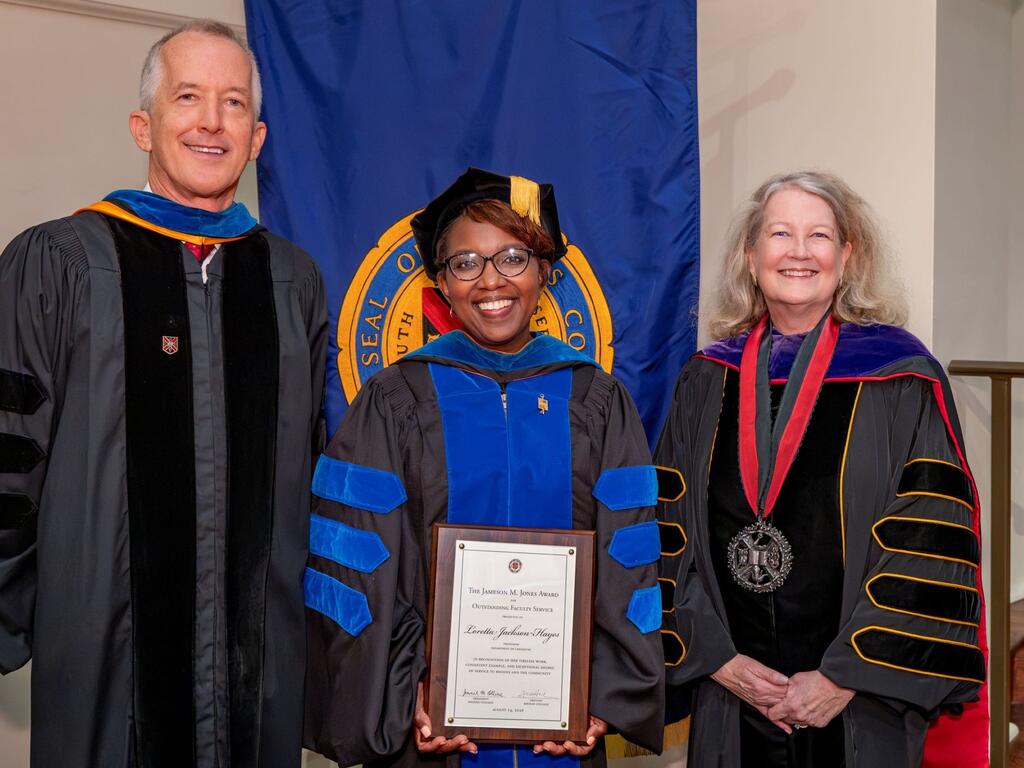
Dr. Loretta Jackson-Hayes, professor of chemistry at Rhodes College, was presented the 2026 Jameson M. Jones Award for Outstanding Faculty Service on Aug. 14 at the college’s Opening Convocation. This is an annual ceremony to mark a new academic session. The first day of classes is Wednesday, Aug. 19.
Established in 1988, the Jameson M. Jones Award for Outstanding Faculty Service recognizes a member of the faculty who exemplifies a deep sense of service to the college’s mission. It is named in memory of Dr. Jameson M. Jones ’36, who served as chief academic officer for more than 15 years.
“The recipient of the 2026 Jameson M. Jones Award for Outstanding Faculty Service has demonstrated a sustained commitment to lead, mentor, and open doors for others throughout her career,” said Dr. Timothy Huebner, provost and vice president for academic affairs, who made the presentation. “Her service has expanded opportunities for students, supported her colleagues across the institution, and extended the reach and reputation of the college into the national scientific community.”
Jackson-Hayes joined the faculty in 2003 and received the Clarence Day Award for Outstanding Teaching from Rhodes in 2015. She was recognized nationally by the Council on Undergraduate Research for her commitment to mentoring undergraduate researchers.
Jackson-Hayes has served as the director of Rhodes’ Biochemistry and Molecular Biology program and chair of the Department of Chemistry. During her tenure as chair from 2019-2022, she successfully guided the department through the challenges of the COVID-19 pandemic, overseeing the shift to remote instruction and the transition back to in-person laboratory teaching. She also led a significant review and refinement of the chemistry major, ensuring the curriculum aligns with the department’s strengths while meeting the certification standards set by the American Chemical Society.
To enhance access to meaningful scientific research, she and Professor Terry Hill have utilized funding from their National Science Foundation-supported research to invite students from Historically Black Colleges and Universities (HBCUs) to work in their laboratories alongside Rhodes students. Additionally, Jackson-Hayes has continued this commitment by inviting underserved high school students to participate in her lab as part of the American Chemical Society’s Project SEED program.
Students who have collaborated with her describe her as an advisor and mentor who combines high expectations with genuine care—someone who offers “honest constructive feedback,” holds students accountable, and uplifts them. As one student noted, “She has not only developed me into an academically successful student but also strengthened my sense of self and confidence.” Her office and her lab are welcoming spaces, where students enjoy listening to her stories and asking her advice.
Jackson-Hayes has made significant contributions to the academic community beyond her department. As the director of scholarly and creative activity mentoring, she established new initiatives to support the work of her faculty colleagues. These initiatives include the Mid-Career Faculty Development Grant Program, a summer grant-writing boot camp, and a mock grant-review program.
Throughout her career, Jackson-Hayes has contributed extensively to shared governance at Rhodes, serving on the Standards and Standing Committee, Educational Program Committee, Academic Space Planning Committee, and Environmental Management Team. She is currently a member of the Faculty Governance Committee. Additionally, she served on two presidential search committees at the college, which led to the appointments of both the 20th president, Marjorie Hass, and the 21st president, Jennifer Collins.
Beyond her work at Rhodes, Jackson-Hayes has demonstrated this same commitment to supporting the national scientific community. From 2022 to 2024, she served as a program director in the Division of Molecular and Cellular Biosciences at the National Science Foundation in Washington, D.C. In this role, she coordinated grant-review panels, mentored new program directors, supported funded scientists, and worked to expand access to federal research funding.
Whether she is mentoring undergraduate research, contributing to the governance of the college, or representing Rhodes on a national stage, Jackson-Hayes’ service is grounded in the conviction that institutions become stronger when they invest in their people. With quiet confidence and dignity, Jackson-Hayes exemplifies the teacher-scholar-citizen model that was so important to Jameson Jones.
“With quiet confidence and dignity, Jackson-Hayes exemplifies the teacher-scholar-citizen model that was so important to Dr. Jameson Jones,” said Huebner.