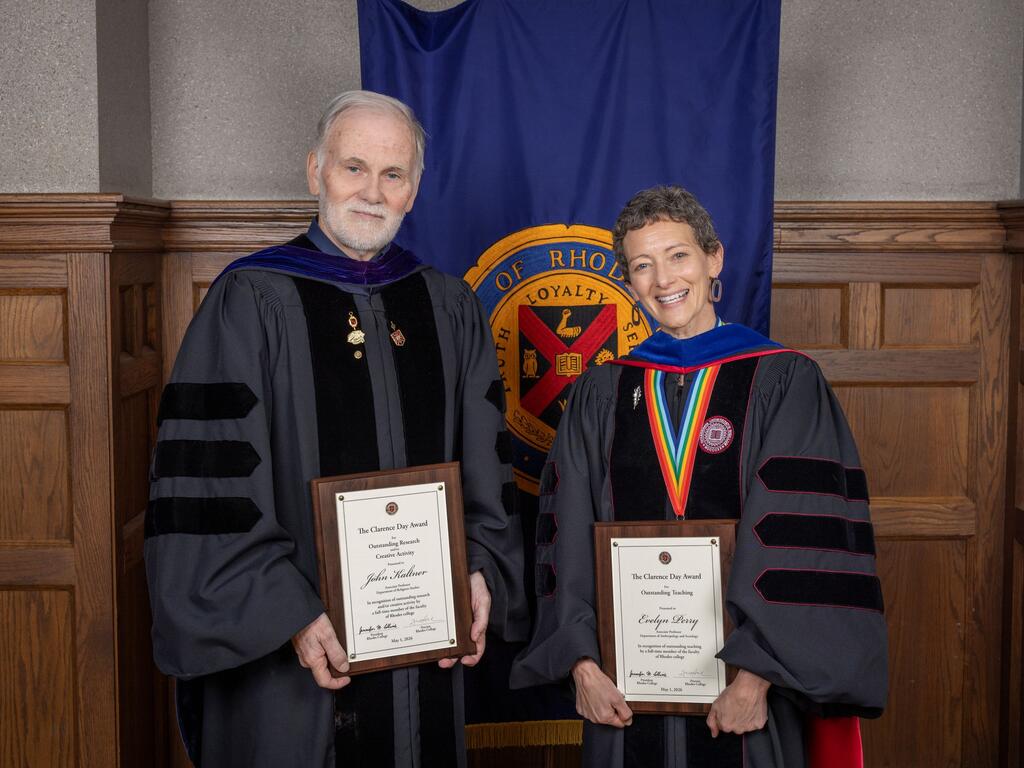
Dr. Evelyn Perry and Dr. John Kaltner were presented with Rhodes College’s highest honors conferred on faculty at the college’s annual Awards Convocation held May 1 on campus.
Perry, an associate professor of sociology, received the Clarence Day Award for Outstanding Teaching—an acknowledgment of her pedagogical excellence. Kaltner, an associate professor of religious studies, was honored with the Clarence Day Award for Outstanding Research and Creative Activity, recognizing his significant scholarly and creative contributions to his field.
These awards, established in 1981 by businessman and Rhodes alumnus Clarence Day, are provided by the Day Foundation.
About the Award Recipients:
Dr. Evelyn Perry joined Rhodes in 2010 after earning a Ph.D. in sociology from Indiana University. She teaches a variety of courses, including Introduction to Sociology, Social Class in the United States, Sociology of Sport, Advanced Research Design, and Senior Seminar. “Through her teaching and mentoring, she has set an exceptionally high bar for what it means to be a transformative teacher at a college that changes lives,” said Dr. Timothy Huebner, provost and vice president for academic affairs, who made the presentation.
Perry’s assignments encourage students to engage with course material in rigorous and imaginative ways, using experiential exercises that explore social identity and creative projects like songs, podcasts, and visual media. Her teaching philosophy focuses on helping students “see themselves as equipped, capable, and sensitive social analysts and change-makers.” One Rhodes graduate noted, “Her philosophy was to teach us how to think, not what to think—this is my most precious gift from the liberal arts education I received while at Rhodes.”
At the core of Perry’s pedagogical success is her generosity. Her office hours are consistently full, and she often meets with students who are not even enrolled in her classes. Her office is described as a space of trust and openness, where students feel comfortable discussing both academic and personal matters. One former student expressed, “When I began to doubt my abilities, Dr. Perry had my back . . . She poured into me the encouragement I needed.”
One student shared that Perry, “continually challenges me to think deeper, ask the hard questions, follow my curiosity, and lead with kindness.” Others have said, “Over and over again, Dr. Perry has taught me self-compassion, how to open my mind and heart, and to never stop working toward a better world.”
In addition to being an exceptional teacher and mentor, Perry is recognized for her contributions to her department, various interdisciplinary programs, and the liberal arts as a whole. A colleague highlighted her “substantial contributions to the curriculum” and willingness to teach more than her share of core courses in support of the department’s needs. Others emphasized the ways she strengthens the faculty community, helping colleagues “foster spaces of trust, reflection, and critical thought” in their own teaching.
“What emerges from these reflections is a portrait of a teacher whose work is not simply excellent but transformative—rooted in intellectual rigor, animated by creativity, and sustained by a profound sense of care,” said Huebner. “At the center of this work is her authenticity: Professor Perry brings her whole self to her teaching and mentoring, and it is this genuine presence that resonates so deeply with students and colleagues alike . . . In every sense, Professor Perry reflects the very best of a Rhodes education and the lasting difference that teaching can make in the lives of our students.”
***
Dr. John Kaltner has been a member of the Rhodes faculty since 1996 and has held the position of the Virginia Ballou McGehee Chair of Muslim-Christian Relations since 2007.
With expertise in Hebrew, Aramaic, Greek, Latin, and Arabic, he is an internationally recognized biblical scholar, specializing in the connections between the stories and ideas found in the Bible and the Qur’an. His first monograph, The Use of Arabic in Biblical Hebrew Lexicography, has become a key resource in the academic community.
Kaltner has published numerous academic books through some of the most esteemed presses, including Yale University Press, Eerdmans, Paulist Press, Bloomsbury, T&T Clark, Brill, and Fortress Press. One individual who nominated him for the Clarence Day Award for Outstanding Research and Creative Activity noted that Kaltner’s work is highly sought after due to his talent “for writing in a way that invites readers in and simplifies the complexities, challenges, and consequences of biblical scholarship.”
In 2023, Kaltner co-authored Jonah: A New Translation with Introduction and Commentary with Profs. Steve McKenzie and Rhiannon Graybill. A nominator commented, “It is difficult to emphasize strongly enough how much time and energy writing a biblical commentary demands. It requires synthesizing virtually all critical scholarship on a particular biblical book, before presenting that synthesis in a systematic manner— chapter by chapter, if not verse by verse. It also requires scholars to chart the terrain of scholarship over a period of centuries in order to contextualize the most recent research . . . biblical commentaries are a huge disciplinary lift—but they are crucial to the production of knowledge in biblical studies.”
In summarizing Kaltner’s work, one of his colleagues remarked: “Few scholars possess the skills and expertise of Prof. Kaltner, and it shows in the impressive body of work he has produced in a steady stream over the three decades he has been at Rhodes. Whereas many scholars have mastered the historical, cultural, social, and literary dimensions of the Hebrew Bible and others are steeped in Arabic and able to work with primary sources in a linguistically sophisticated manner, exceedingly few are qualified to make scholarly contributions that bring these two disciplines together in innovative ways. That he carries his learning so lightly and makes it look so easy is a testament not only to his academic accomplishments but to his personal character as well.”
Kaltner shows no signs of slowing down, as he has new co-authored and co-edited volumes expected to be released in the coming academic year.