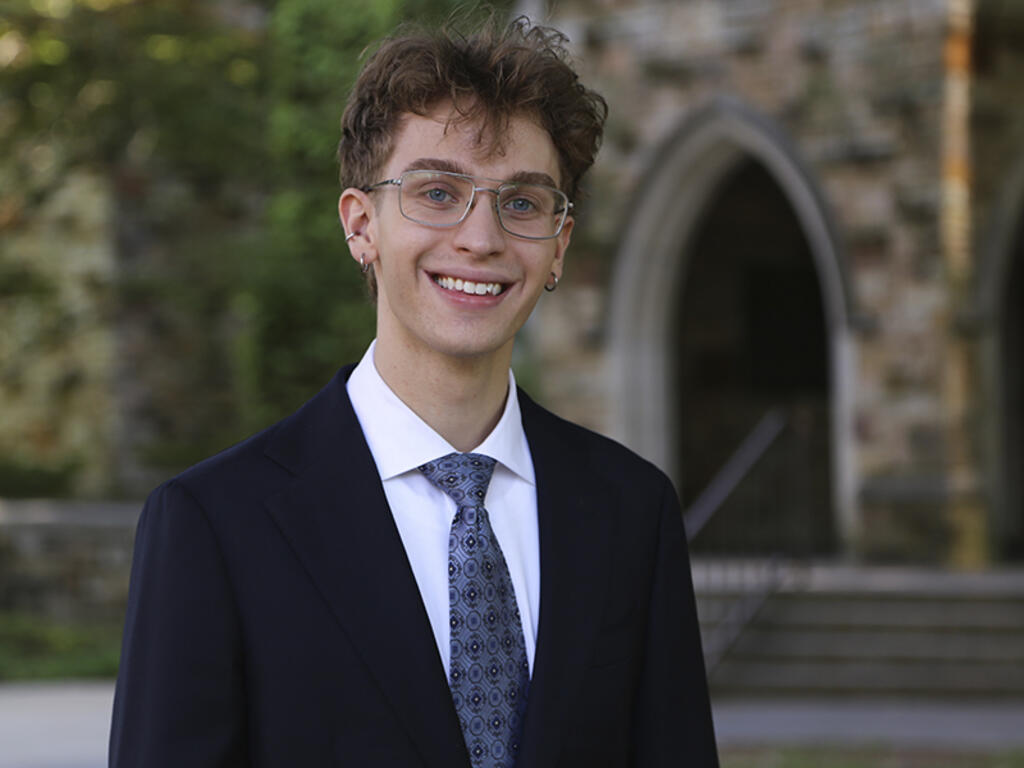
In making his college decision, the top priority for urban and education studies major Mitchell Leander was community. “I knew I wanted to go someplace where I could do a lot of different things, and I knew that I would be really supported at Rhodes,” says the Nashville native. “Another big reason was because historically the mock trial team is the best in the country. I am interested in law and wanted to learn what it meant to use law as a tool for advocacy.”
Now a junior, Leander has participated in mock trial since his first year at Rhodes. Before competitions, he has the opportunity to practice in-court litigation and trial advocacy in front of local attorneys and judges—some Rhodes alumni—who give him constructive feedback, consistently helping him shape his arguments for further invitational and regional tournaments. “The experience of being able to articulate my case, articulate my arguments, there's nothing better to prepare me for a career in law than mock trial.” This year, Leander captained the most competitive team at Rhodes and was named an All-American Witness at the American Mock Trial Association National Championship.
In addition, he is a student volunteer in Rhodes’ Liberal Arts in Prison program, working with incarcerated individuals at the Women's Therapeutic Residential Center (WTRC), which is part of the West Tennessee Penitentiary. “I do a lot of work with the issue of incarceration, and you can feel like the work you're doing might not have a longer impact. But working hands-on with people on a day-to-day basis, I know at least: I have the experience of working with an incarcerated individual who is now feeling like she not only has a better shot at her parole hearing and prospects following incarceration, but also she's experiencing what it means to enter into a classroom, to feel a sense of community with the other women and with students from Rhodes.”
The program influenced Leander’s decision to pursue education as a second major in addition to urban studies. “I had thought that legislation, and creating policies that create safe and healthy communities, were the most effective tools in becoming an advocate and agent of change. While that is important, the Liberal Arts in Prison program has been a really meaningful experience, and one in which I realized that a lot of the things I want to do are best done through education.”
Leander is also helping to replicate the Rhodes mock trial experience for eligible WTRC students; initially, the program will start as a club, with the goal of eventually having a team that competes.
“We're following the Rhodes model of starting small and then scaling upwards. We want to take what we do here at Rhodes and transplant it into the carceral environment. We'll be starting exactly how we learn mock trial, which is: What are the rules of evidence? What does it mean to write a direct cross examination? What does it mean to construct a case as a team? By aiding their knowledge of the judicial system, how to work within it, we hope to provide these women with an opportunity to reclaim ownership of their autonomy.”
To be involved in advocacy work in Memphis, Leander joined Just City Advocates, a student organization that works with Just City, which is a local nonprofit organization that supports incarcerated persons. Today, he also works directly for Just City, starting as a court watch intern his sophomore year and now as a court watch coordinator.
On campus, Leander is a member of the Community Standards Council. “On the council we’re constantly trying to find the best solution when we consider a case; not for punishing a student, but saying, ‘How can we create a safe community on campus that both honors the broader campus, as well as the student involved?’ That experience of being in a room with other people negotiating those priorities has been really valuable and brings that work back here on campus.”
Leander has also furthered his connection to Memphis through his music minor and his fellowship with the Mike Curb Institute for Music. He serves on the event planning committee, where his main interest is bringing Memphis music onto campus. “Curb offers the opportunity to really connect authentically with the surrounding music community.”
Whether it’s his dedication to the Curb Institute, Just City Advocates, mock trial or to the students he tutors at the Liberal Arts in Prison program—Leander says he gives his all.
“We cannot solve the world’s problems in a day. The best thing we can do is wake up each day and say, how am I going to push the ticker just a little bit in the right direction? How am I going to push that needle just a little bit further? It serves to look at it pragmatically and say, ‘I cannot carry the weight of the world, but what I can do is shout about this one issue, or push for this one thing to be solved, or listen to someone about what's going on in their life, understand that better, and institute that into my worldview.
“Just take it one piece at a time. My mom used to always say, how do you eat an elephant? One spoonful at a time.”
By Simran Kumar '26