The Department of Music Helps Students Score Their Own Musical Stories
Music mavens have flocked to Memphis, seeking a flash of inspiration from the rich tapestry woven by icons of the blues, soul, and rock n’ roll. W.C. Handy took blues from Beale Street to the world, and B.B. King’s sophisticated electric blues and Elvis Presley’s hip-shaking rock swagger paved the way for generations of luminaries to follow. Al Green, Isaac Hayes, Justin Timberlake, Three 6 Mafia, and Glorilla are but a few major artists to have honed their craft in Memphis, harnessing the heritage and culture of the Mid-South to carve out their own spaces. With such a well to draw on, there aren’t many better places for aspiring musicians to get their start, and the Department of Music at Rhodes is always ready to shepherd students from the classroom to the stage.
It’s a common occurrence to hear the melodious notes of a piano or a soprano’s vocals drifting from Hassell Hall throughout the day. It could be classical, jazz, pop, or a student simply getting some extra practice in. They gather to practice composition, hone their performance skills, or chat with professors. There are so many paths to take in the world of music, and the department stays on its toes to constantly evolve and meet the needs of students. But composition and performance only scratch the surface of what students can expect. “We’ve redone the theory curriculum three times since I arrived in 2000,” says Courtenay Harter, department chair and professor of music theory and music cognition. “We have a lot of music majors, but many students from other majors also come to the department, so we redid the curriculum to where every single student would get an excellent foundation of music theory, and possess the vocabulary to further their music education and tie it in to their major.”
It’s a common occurrence to hear the melodious notes of a piano or a soprano’s vocals drifting from Hassell Hall throughout the day. It could be classical, jazz, pop, or a student simply getting some extra practice in. They gather to practice composition, hone their performance skills, or chat with professors. There are so many paths to take in the world of music, and the department stays on its toes to constantly evolve and meet the needs of students. But composition and performance only scratch the surface of what students can expect. “We’ve redone the theory curriculum three times since I arrived in 2000,” says Courtenay Harter, department chair and professor of music theory and music cognition. “We have a lot of music majors, but many students from other majors also come to the department, so we redid the curriculum to where every single student would get an excellent foundation of music theory, and possess the vocabulary to further their music education and tie it in to their major.”
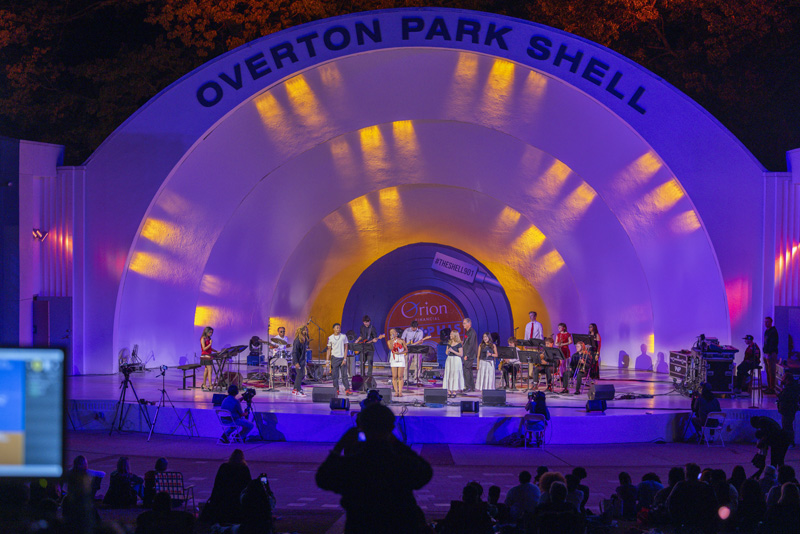
The Mike Curb Institute for Music led by John Bass, is frequently cited as a major player in the college’s music impact, having been recognized by Billboard as a Top Music Business School five years in a row. The Curb Institute involves students in all aspects of the music business, from sound editing to video production to marketing. Students gain experience working with professional artists, interning in recording studios such as Willi Mitchell’s famous Royal Studios, producing musical events at venues such as the Overton Park Shell, and doing research at the STAX Museum of American Soul Music. The Institute’s scope has seen it add creative new classes to the curriculum, from Music Urbanism to Songwriting in Memphis (the latter featured in the Summer 2024 issue of Rhodes magazine).
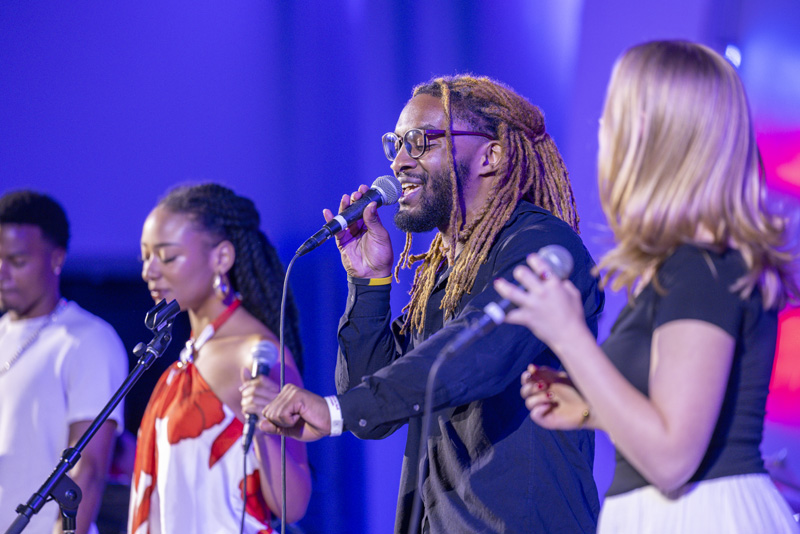
That creative approach to class creation department-wide has brought new focus to ways that music can collaborate with other departments. “Rhodes students are always asking new questions that make us think about things in new ways. It’s all about being creative with our classes and finding new ways of integrating music into a curriculum,” says Harter. She points to the Music and Psychology major as a prime example of an interdisciplinary approach that fits a real-world need. “We’d seen a lot of students who wanted to pursue a career in music therapy after graduation, so we sat down with the psychology faculty and created this robust curriculum where students will be proficient in both music and psychology.”
Harter also references Post-Tonal Theory, which analyzes modern music of the early 20th century through set theory. Students categorize musical objects into numbers and describe their relationships, before turning those numbers back into music; the upper-level class fuses a high-level understanding of theory with mathematics. Performance and Analysis pivots to a writing-intensive approach, where students build their awareness of the element of music and work to describe it through the written word.
“There are many interdisciplinary approaches with other departments,” says Harter. “But music itself is interdisciplinary. We have performance, composition, history, and so many other facets. Students come to us asking what they can do with their music major, and the answer is anything. We’re here to help them focus on where exactly they want to go and make sure they get there.”
Music majors also get the chance to interact with world-class performers thanks to programs such as the Springfield Music Lecture Series, named for John Murry Springfield ’51. Some of the recent Springfield guests have included Grammy-winning artists Sheila E. and Jason Isbell. Isbell spoke to the Curb Institute for Music’s Songwriting in Memphis Class, while Sheila E. performed alongside the Rhodes Jazz Ensemble. “We’re able to secure artists, scholars, and performers who connect to our classes and what we’re teaching. So in that sense, we’re doing something local that can combine with these global influences.”
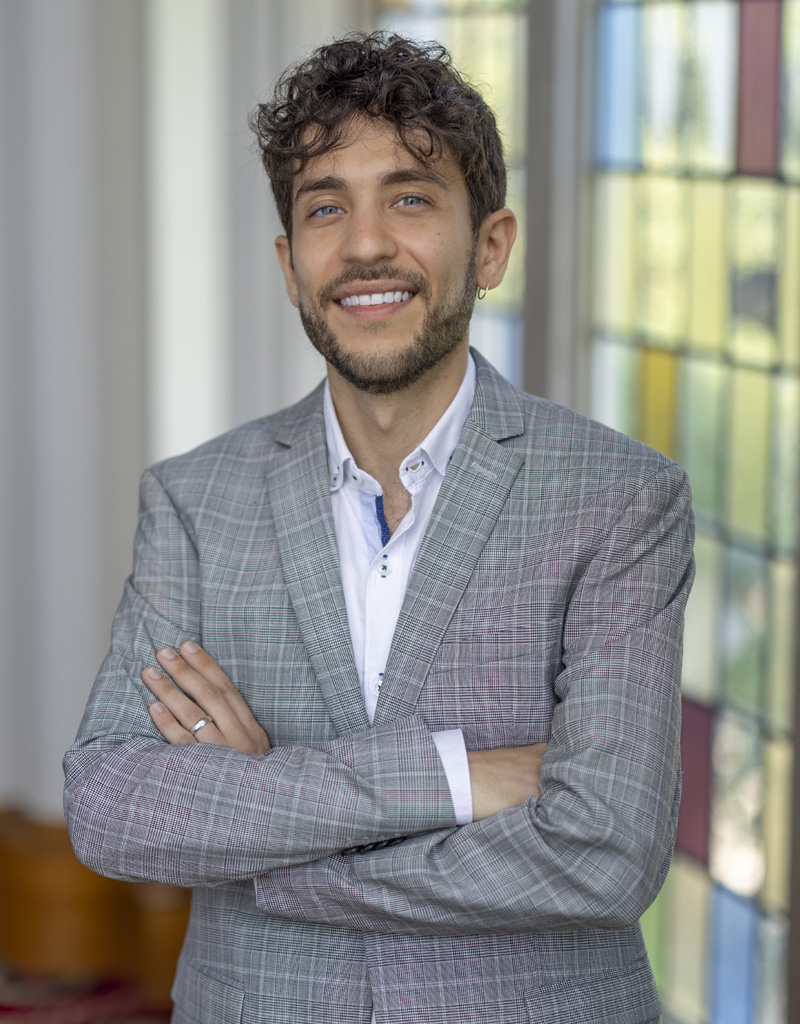
Faculty member Jacob Sunshine, assistant professor of music, teaches a dynamic range of courses that incorporate many of those global influences into the classroom. Specializing in sound cultures from the Caribbean, Africa, and the United States, Sunshine’s remit when he joined the faculty in 2023 was to focus on that global approach. His classes take an international approach, but many of them also hone in on popular music.
“Rather than high art music, these classes focus on music that is available and a part of cultural life of, I’d say, just regular people around the world, dance music especially,” says Sunshine. Music Cultures of the World explores popular music from Africa, Latin America, and many other regions, with styles including Gamelan from Indonesia and Qawwali from South Asia. “A lot of this popular music around the world stems from religious tradition. A good analog to this is gospel music in the United States, and the way that filters into popular music here. It’s musicians taking little kernels of what they learned in these devotional spaces and bringing it into the more mainstream popular contexts.”
One of Sunshine’s more popular classes is DJ Cultures and Dance Environments, which examines dance music scenes and the spaces in which communities congregate, and overlaps with Rhodes’ new dance minor. “In these histories of dance culture, they’re actually pretty subversive political spaces where the most marginalized folks come together to party effectively, and you also see boundary crossing, where communities that might not have come together in the first place start to form these spaces.”
The electronic dance music focus in the class, which includes international spaces and a focus on Memphis hip-hop, has been appealing to students who are already interested in that genre of music. But it also traces a counter-history of communities of resistance that may not have found their way into the history books. “Sometimes these communities can herald things that are to come,” says Sunshine. “If you look at activist movements in America, movements like anti-apartheid in South Africa, a lot of these ideas got distributed in this dance context. And something like that is really intertwined with a place like Memphis, which has a deep history of both music and activism.”
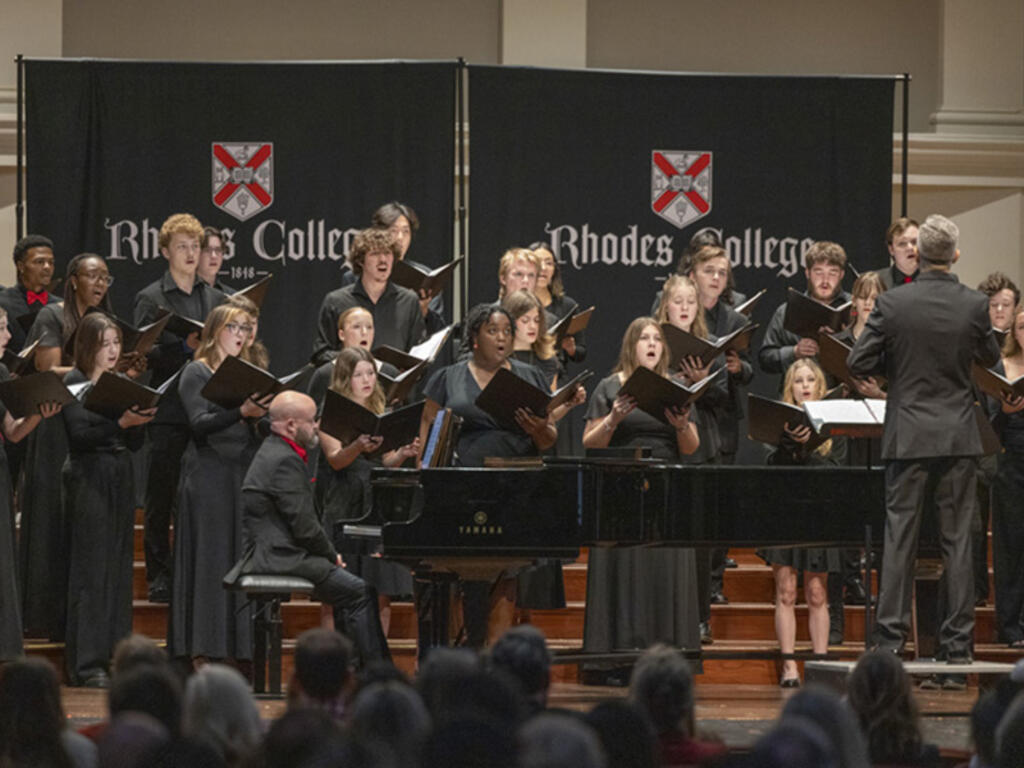
While majors hone their understanding of music theory and history in the classroom, many are drawn to the department’s diverse vocal and instrumental ensembles available to all students. The Rhodes College Orchestra and Rhodes 100 Pep Band led by Jonathan Schallert, David Shotsberger’s Rhodes Jazz Ensemble, and Sunshine’s Archipelago Ensemble frequently perform on campus and around Memphis, while Chamber Ensembles offer more intimate experiences for students to further their performance skills. Many of these ensembles are deeply intertwined with Rhodes’ legacy in Memphis, but perhaps none more so than the Rhodes Singers vocal ensemble. Originating in 1934 under Louis Nicholas ’34, the program was cemented by Burnet C. Tuthill in 1937 and has been woven into the fabric of the college’s history. For almost a century, the college’s flagship vocal ensemble has performed a wide variety of choral repertoire in Memphis and around the country. Their prowess has even seen them tour internationally, with stops in Dublin, Rome, Poland, the Czech Republic, and many other destinations.

For conductor Jason Bishop ’98, who also leads the Rhodes Choral Collaborative, taking up the mantle and continuing the Rhodes Singers legacy was a driving factor in his return to the college in 2024. “We’re not just integral to the history of music at Rhodes,” he says, “but we’re integral to the history of music in Memphis. The Memphis Symphony Orchestra has its origins here as well, which was also founded by Tuthill.”
As a student, Bishop came to Rhodes with an interest in both languages and music, with a focus on Greek and Roman studies. Choir, it turned out, was the best path to pursue both. “My very first choir experience was right here at Rhodes, as a member of Rhodes Singers under Tony Lee Garner ’65, who had been here since the ’60s,” says Bishop. “I’d never done choir before, and I didn’t know at the time that choral music was an intersection of those two things. And the discovery that I could do both was huge for me.”
During Bishop’s senior year, Garner was unfortunately battling terminal cancer. The conductor decided that he would train Bishop to lead the ensemble when he was too ill and taught his understudy through intensive conducting lessons. Bishop ended up leading the Rhodes Singers tour his final semester, before Garner passed away later that summer.
The poignant experience has stuck with Bishop throughout his career. “It was nerve-wracking since I didn’t have a long history as a musician. But it was a professor who had confidence in me, and the willingness to push me. It was absolutely trial by fire, but in a very good way.”
Now back at Rhodes, Bishop feels a custodial responsibility as he takes the Rhodes Singers forward. “It’s as if I’m taking care of this really important program that, in a way, took care of me when I was a student.” Reflecting on his experience is a crucial part of how he views the Rhodes Singers as a whole. As the world continues to rapidly develop, he says, sometimes it’s beneficial to take a breath and study what’s come before. “In today’s world, there’s sometimes change for the sake of change and a focus on the next new thing at the expense of values and traditions. The world is developing at a more rapid pace than most of us have experienced in our lifetimes, so I think it’s really important for an institution like Rhodes to be able to look at this program with an almost 90-year history. It tells us a lot about who we are as a campus that we originated with music pretty high on our priority list. In that way, it’s really part of our DNA as an institution.”
In May, Bishop is taking the Rhodes Singers on its first-ever tour of the Baltic states, with stops in Estonia, Latvia, and Lithuania to come the week after Commencement. “It looked like it could be a really fulfilling experience both musically and culturally,” says Bishop. “And that really fits into the ethos of our music department: to touch all things we think are required to be a complete musician. That’s theoretical knowledge, historical and cultural knowledge, and performance experience. And keeping this tradition going for further generations of students is a part of how we make that happen.”