By Sam Cicci '15
David McCarthy — Professor of Art and Art History
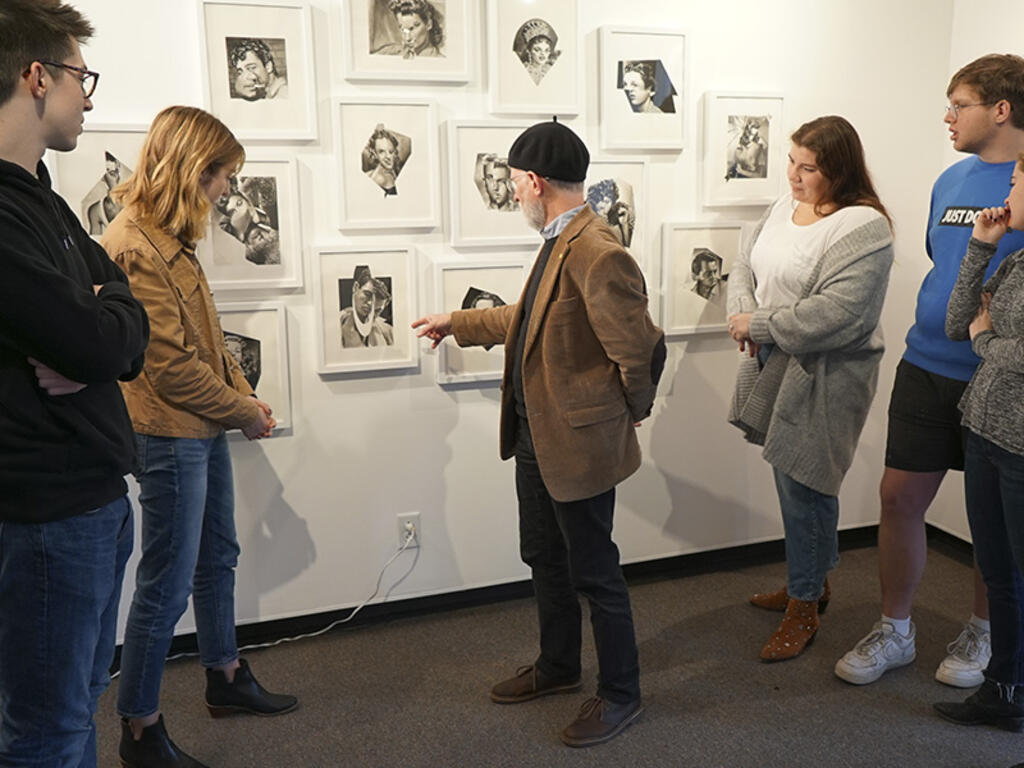
Perhaps the most difficult part of leaving campus was transporting the vast collection of art, office decorations, and books David McCarthy had accumulated from his office to his home. “This was floor to ceiling books before,” he says on a warm spring day from inside an admittedly still-full office. The objects lining the shelves and hanging on the walls trace every school year since his arrival at Rhodes in 1991: the students he has helped shape, gallery openings featuring art he has covered for decades, and projects conducted in tandem with community partners such as the Memphis Brooks Museum of Art.
McCarthy’s mother was an art enthusiast and a librarian, which meant growing up he perused art books she’d bring home and made frequent museum excursions. He watched his grandfather turn pieces of cardboard into beautiful landscape portraits in the basement atelier of their Boston home. McCarthy’s introduction to art has always fueled his approach in the classroom. “I was smitten watching my grandfather create, and my mother exposed me to the art history side of things. In my experience at graduate school, it was strictly one or another when it came to studio art versus art history. One of the things I really value about the department here is that we worked hard to eradicate that line between work in the studio and art history. Here, those lines are completely permeable.”
During his years at Rhodes, McCarthy, who received the Clarence Day Award for Outstanding Teaching in 2023, has been adamant that teaching and his independent scholarship are not separate pursuits. “What I’ve always found is that students bring their own unique experiences and perspectives to the conversation, and sometimes they take you in directions you could not anticipate,” he says. “So whether your audience is students just learning the ropes, or scholars who have dedicated their lives to this, there are still possibilities of discovery in both.”
Throughout his career, McCarthy made a point to walk through Clough Hall several times a day, stopping to absorb the artwork created by students that hung on the walls. “I have new moments of revelation all the time,” he adds. “It’s deepened in the sense that, especially as Rhodes has diversified its faculty and staff and its student body, the students and my colleagues have a much wider frame of reference than I had coming in here 35 years ago, and that the school had 35 years ago. And with that, it means that every single occasion that I have to talk with the students about their art in the studio, or to talk to them about stuff in the classroom, means that the possibility for learning more from my perspective has just increased over the years.”
Much of McCarthy’s research has focused on American, Contemporary, and Modern art, and how artists mold and reflect the times in which they live. Notably, McCarthy has interrogated how American artists have depicted the causes and effects of war through their art, chiefly through the work of American printmaker and sculptor H.C. Westermann. “I’ve long been attracted to art that has, let’s say, a point of view or an attitude,” he says. “What I really value is the way in which artists use their creativity to talk about the world around them. I think of it as casting a vote, but doing it in public because their work is on display.”
McCarthy built his own faculty capstone after assistant professor of art Joel Parsons ’07 encouraged him to host a final exhibit in the Clough-Hanson Gallery this past spring. A Well-Trained Eye: The Work and Collections of David McCarthy gathered works from his personal collection, centering many of Westermann’s works, delving into themes of anti-war and familial influence, but also showcasing student collaboration and engagement with Memphis artists. “As we were putting this together, my wife and I looked through much of the art we’d collected over the years from Memphis artists,” he says.
Notable attention was given to the Memphis World Catalogue, a research partnership with the Memphis Brooks Museum of Art from 2007 and 2008. McCarthy and students worked alongside the Brooks to collect old photography from the Memphis World, a Black newspaper that circulated from 1931 to 1973 and gave voice to members of the Civil Rights Movement. “Like a prior catalogue we’d done on Pop Art, these projects really gave students a tangible way to interact with Memphis work and its history,” he says.
But while McCarthy’s time as an academic tied to Rhodes College has come to an end, his pursuits as a scholar will continue. “I have no plans to give up my life as an art historian,” he says. “I have a couple of essays in the pipeline. There are some pieces at the Brooks I’ve had my eye on for years. I’d like to do some research about those things, and I’ll just keep plugging away and look for new opportunities."
Darlene Loprete — Professor of Chemistry
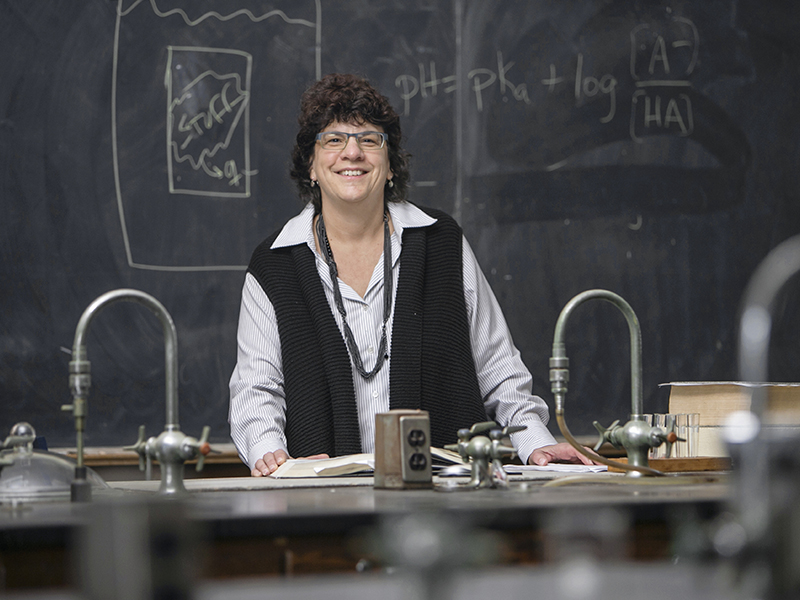
What do mushrooms and people have in common? A lot more than you might think, with the two sharing nearly 50 percent of the same DNA. While the HBO hit show The Last of Us brought that connection into the wider pop culture zeitgeist with a fantastical take on the subject matter, outgoing professor of chemistry Darlene Loprete spent a large chunk of her career focusing on more tangible possibilities born out of those similarities.
“Fungi are good and bad,” says Loprete. “They give us things like beer and wine. But they’re also pests. They cause diseases; you can get a fungal lung disease if you have a compromised immune system. People get toenail fungus that’s hard to get rid of. And some of the drugs to treat those are very rough on the body. Fungi are very similar to us, but one distinguishing factor is the cell wall. If you wanted to design an antifungal drug, that would be the place to start. So a lot of my research has been towards analyzing that cell wall, and how that can be used to specifically target fungus in the body and not your own cells.” Loprete’s research focused specifically on the Aspergillus nidulans, a filamentous fungi used as an important focus of cell biology.
A biochemist by trade, Loprete grew up loving science and knew she would work in the field. “It was always just a matter of where I was going to land,” she says. In graduate school at the University of Rhode Island, faculty lauded her talent for presenting her ideas and synthesizing them for others. “So I thought, well, maybe I should go into teaching.”
After receiving a PhD, the New Jersey native accepted a position at Rhodes in 1990 and decamped to Tennessee, her first time in the South. But her culture shock didn’t last long, and she quickly embraced the Rhodes experience. “I’d interviewed other places, but the quality of students was certainly attractive to me, and it being in a very rich medical community with St. Jude Children’s Research Hospital, University of Tennessee, and the University of Memphis all around the corner. When I was starting out, most schools had separate biology and chemistry departments, but Rhodes allowed us to combine those fields in interesting ways.
“Plus, I really wanted to be in a metropolitan area,” adds Loprete. “Having grown up just 20 miles outside New York City, that was a must. Luckily, Memphis ticked all the boxes.”
Loprete conducted research with professor of biology Terry Hill and professor of chemistry Loretta Jackson-Hayes, among others, and worked closely with local organizations such as Buckman Laboratories. And she also found a wealth of students eager to learn on the job. “We had lots of students who had a thirst for something extra outside the classroom. I’ve taken students who have just been here one year and want a summer opportunity, or those who want to be part of a lab during the semester,” she says. “My goal was to teach students enough about what we’re doing, even if they didn’t have the classroom background to do it. Some students outside the chemistry track would express an interest, or I would invite others who displayed good techniques to join me in the laboratory. And it was always really fun to get groups of students together in the lab and have them learn from each other.”
Loprete would stagger her research teams, retaining a couple of students each year to mentor new students coming into the lab. She enjoyed creating opportunities for students to share this research, traveling nearby to North Carolina or farther afield to Copenhagen, Denmark. “It was always really rewarding to travel to conferences around the world and show my colleagues in the field what our students had been working on,” she adds.
For much of the last decade, Loprete stepped back from research to focus on the classroom and other administrative work. “There was a really intense period where I did a lot of research, but that wound down and I turned my focus elsewhere, such as acting as the department chair for several years. That kind of work keeps you busy, but I still found time to take students to conferences and share their work.”
Post-Rhodes, Loprete will travel, play some tennis, and continue to uphold Rhodes’ commitment to service by volunteering around Memphis. “I’ve always played tennis, so I’ll continue to do that, alongside getting better at golf. I’ve got the Country Music Festival in Nashville on my radar, the Cincinnati Open tennis tournament, and then our annual family gathering in Atlantic City. Then of course I’m a wine lover, so I’ll go to Oregon to drink some wine.”
Dee Birnbaum — Associate Professor of Business
With her eye on pursuing a career in music, Dee Birnbaum could have let an early osteoarthritis diagnosis derail her. A lifelong interest in artistry and performance—after discovering she had perfect pitch at five years old—was upended when doctors recommended that she quit playing.
“I’d fallen in love with the cello as a kid, and played in music festivals and got a music scholarship to college,” says Birnbaum, who retired as associate professor of business in December. “But I started having trouble with my hand. I wasn’t able to play or hold my bow, and was feeling pain when I carried my case around. So I had to give that up.”
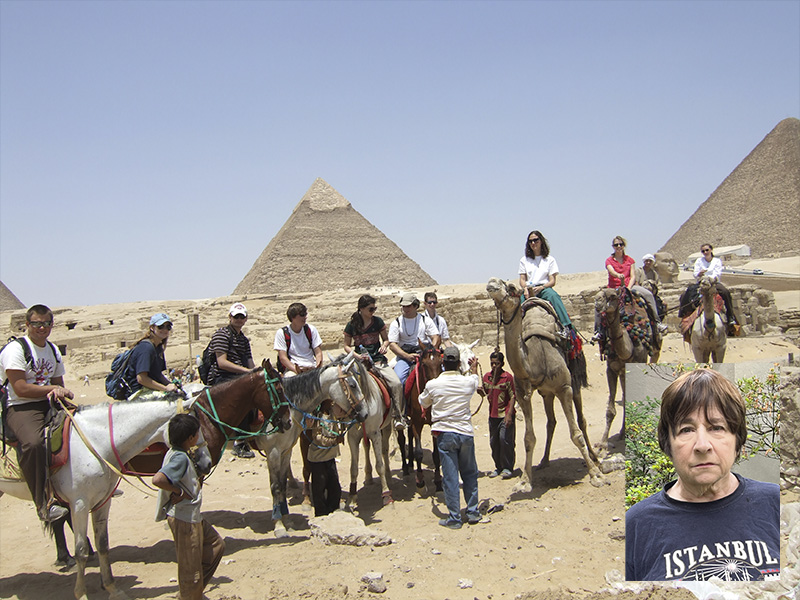
But any of the students who took a class with Birnbaum during her 35 years at Rhodes know she’s not one to give up easily. A career as a professional musician may have been swept off the table, but she took the no from doctors and flipped it into a resounding yes: yes to a lengthy career in academia working around issues she was passionate about, and yes to traveling the world with students as she shared her expertise in Middle Eastern dance and jewelry.
But immediately after making the decision to walk away from the cello, Birnbaum reflected on her doctor and hospital visits and pivoted to healthcare. She worked as a hospital administrator in New York City before she pursued an MBA in healthcare management. She became interested in the intricacies of running a hospital and, at the time, the worldwide shortage of nurses. “I eventually decided I wanted to pursue my doctorate focused on the business of running a hospital and healthcare.” After earning a PhD, Birnbaum taught healthcare management at University of Kansas and then Tulane University in New Orleans. While she was mulling over a change of scenery, she met an acquaintance who had worked at Rhodes. “I looked into it and heard really good things about the school,” she says. “I visited twice, met the administration, and thought ‘yeah, ok, this is it.’”
Birnbaum relocated to Memphis in 1991 and was immediately taken aback by her classes. “I was used to teaching graduate students, but I was amazed at how good the undergraduates at Rhodes are compared to when I’d been teaching master’s and doctoral students.”
Once she found Memphis as the place she wanted to be, she continued the globetrotting adventures she’d started in the ’70s, taking a deep dive into Middle Eastern culture. She took interest in a wide variety of Middle Eastern forms of dance, full of fluid movements that allowed her to reconnect with music without aggravating her arthritis. “Lots of the movements allowed me to dance and strengthen my body. I practiced and performed regional dances, called folklore, from Egypt and Lebanon for a long time, and also taught seminars at Rhodes and around the country.”
Birnbaum had also been gathering textile and jewelry throughout her travels, picked up from bazaars she would frequent or presented as a gift from one of the many host families she’s stayed with over the years. Her personal collection is vast, encompassing pieces from North Africa, the Middle East, and Central Asia. “During one of my early travels to Afghanistan and through India, I was really taken with these small pieces of silver jewelry I saw, just going into shops,” she says. “That’s kind of where it got started, and I just kept collecting. I was fascinated with small towns in Syria; in each town the women would make their own clothing, and they’d all use different embroideries and colors. You could trace where people were from based on the design, and so every piece is an important cultural design.”
Many of the pieces decorate Birnbaum’s house in Memphis, with jewelry carefully arranged on tables and textiles and apparel hanging in every room. Many of the pieces in her collection are on display in the Dee Birnbaum Collection of Textiles and Jewelry at Indiana University: shawls, tunics, pants, veil ornaments, handcrafted bangles, and jeweled necklaces are just some of the many items on display, and she has no plans to stop collecting. “A lot of these are very personal to me,” she says. “I’ve made a lot of friends during my travels, and many have gifted me with these beautiful things after hosting me. You can learn so much about culture, politics, anything, through items like these.”
“It’s crazy to think about, but I’ve been to a lot of interesting places,” adds Birnbaum.
“I fell in love with Egypt, everything about the culture, and was able to take students on a few semesters abroad there to work with small business owners and see how they operate. I’ve been to Tunisia, Morocco, Syria, Afghanistan, Lebanon, and so many other places. And now that I’ve retired, the traveling will continue.”
Tom Bryant — Associate Professor of Music
Associate professor of music Tom Bryant’s passion for piano and all things musical started out as more of a competitive rivalry. “I’m the youngest of three brothers,” he says, “and my mother signed us all up for lessons when we were kids. So we had that element of ‘oh, I can’t lose to my brother.’” While his siblings moved on to other things, Bryant’s talent shone through in his early lessons. By the sixth grade, he was performing at his church, and he hasn’t looked back since.
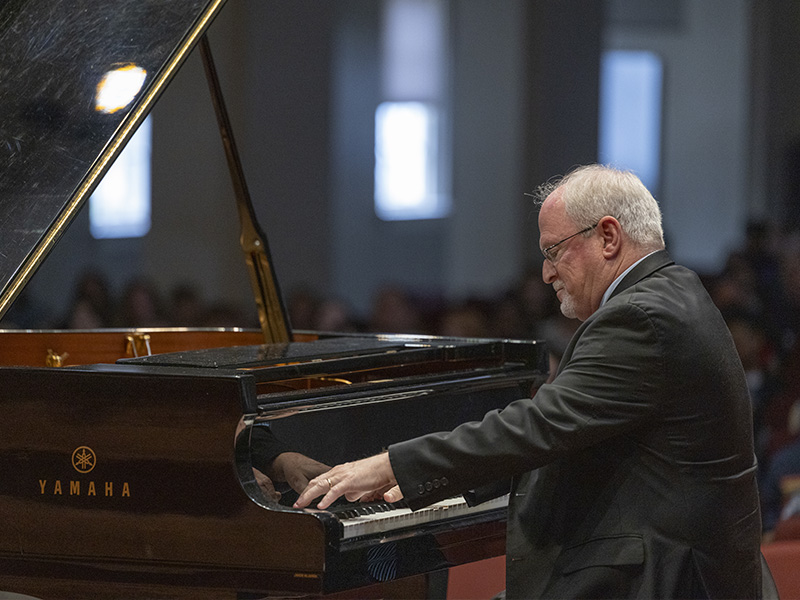
The Rhodes community has been graced by many of Bryant’s confident and composed performances since he arrived on campus in 1990. Echoes of Schubert, Beethoven, Mozart, Chopin, and Rachmaninoff, some of his favorite composers, shine through as his fingers fly across the keys. But Bryant doesn’t simply take the stage to show off his incredible solo prowess. Rather, he sees himself as support for the many talented students who desire to take the stage.
“During a [Rotary Foundation International] Fellowship at the Vienna Academy of Music in Austria, after my undergraduate studies, I found that I really excelled in collaborative piano,” he says, “accompanying singers, violinists, cellists, and all sorts of groups.”
Bryant’s April 26 concert, Prelude to the Ninth featuring Beethoven’s Choral Fantasy, performed with the Rhodes Singers and Choral Collaborative and organized by assistant professor of music and director of choral activities Jason Bishop ’98, was one of the most memorable of his career. “It was almost like the whole department came together for my retirement. I’ve enjoyed every performance, but getting to be a concerto soloist alongside our choir and orchestra students was so meaningful. But I look back fondly on many of the performances, both with students and with other faculty members, whether it was a piano quartet or my frequent collaboration with [professor of music] Carole Blankenship ’85.”
If his performances have always looked effortless, Bryant’s skills were forged in fire during his four years of undergraduate studies at the University of Georgia. “We had this very small instructor, and she was the most intimidating person we’d met,” recalls Bryant. In between her shouted instructions and demanding methods, he could glean her desire for improvement. “It was very tough, but I could always feel the bar rising, and I could see that she was communicating to me that she knew I could do it, she believed in me, and she really was the greatest teacher. And she was the one who recommended me to Vienna.”
While his undergraduate experience was very old-school, Bryant’s approach to class takes a much more supportive tack—an approach that fits in very well with Rhodes’ Department of Music. “Our department is unique in music education in that we’re all very supportive of each other,” says Bryant. “We of course have healthy disagreements, but all the faculty are supportive and encouraging of each other’s corners of the music world. The support from colleagues, and the challenges from students, keep us on our toes and push us to improve.”
In the classroom, in lessons, and even when out just enjoying concerts, Bryant views music as a form of nourishment. While academics and athletics feed the body and mind, Bryant views music as feeding the soul, with benefits to all students no matter their discipline. “You can’t give anything to anybody if your cup is empty,” he says. “Music fills your cup, it can be healing to the soul, it can get you through the death of a loved one. It can be fanfare, celebratory. It’s a realm that’s kind of abstract, but it makes you a better person, a better lawyer or physician. It’s what keeps us human.”
The greatest reward, he adds, is watching students who attend a music class solely for the credit start to open up. The early weeks of a semester, in his experience, sees these students hang back, mildly disinterested, before the subject matter slowly reels them in. “I wait for the moment when they uncross their arms, lean forward, and become engrossed.”
To make his love for music infectious, Bryant has always sought to make sure his passion and enthusiasm is at maximum for each class—a lesson he learned from his son, Sam. “My son has Down syndrome, and I’ve found young men and women with Down syndrome are the happiest creatures on earth. There’s no filter, which can work against you, but it gives you a confidence and vulnerability that you need to embrace when you’re getting up on stage around hundreds of people.
“He shows me an unconditional love which has really informed my teaching philosophy,” he adds. “And I need to bring that same unconditional love for music into the classroom to keep our students engaged. If I can bring a tenth of what Sam shows on a regular basis to the classroom, that’s success, and seeing him embody this every day has made me a much better professor.”
While stepping back from full-time teaching, Bryant will still be a regular face around campus, stepping in to teach part-time. He will also continue to host solo piano lessons for interested students. “Piano and music have blessed my life in so many ways, and I want to continue to convey that passion to others.”
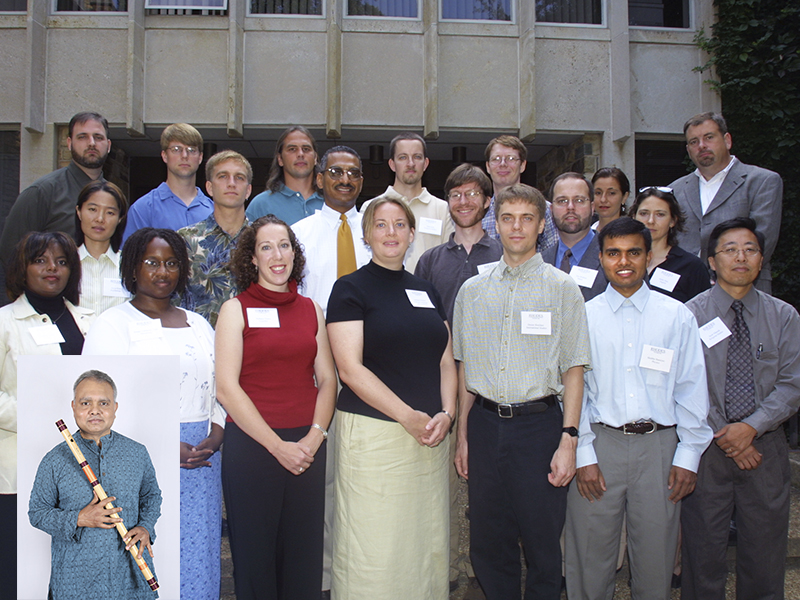
Shubho Banerjee — Professor of Physics
When he first set foot on Rhodes campus, professor of physics Shubho Banerjee was enthralled. The Collegiate Gothic buildings, standing quietly on a brisk winter day, were unlike anything he’d ever seen before.
“Rhodes has such a different character in the winter,” he says. “I’d come to campus to have my first ever interview for a teaching position, and I kept thinking ‘I really hope I get this job.’” Rhodes proved to be his first and only interview for a teaching position; after starting in 2002, he decided that Memphis was the right fit for him and made the college home for a near-quarter century before his retirement earlier this year.
The world of physics and science is almost the family business for the Banerjees. “I really grew up in a physics household,” recalls Banerjee. “My mother has a master’s in physics. My younger brother ended up being a physics professor. My younger sister is a mechanical engineer, but she is married to a physicist, and their son just finished undergraduate with a degree in physics.”
It was almost ordained, then, that he would immerse himself in that world. But he dipped his toe into a bit of everything during his five-year spell at Indian Institute of Technology, Kanpur. “We did a lot of mathematics, chemistry, electrical engineering, mechanical engineering, you name it.” Those five years solidified his resolve to work in physics, and his next steps took him to a PhD program at Carnegie Mellon University in Pittsburgh, PA, followed by a two-year postdoctoral appointment at the University of Maryland, College Park.
As he grew into academics at Carnegie Mellon, Banerjee had taken on a teaching assistant position. His open door policy proved so successful that students would constantly be in his office, setting up camp to do homework, chat with each other, or just pass the time. “I enjoy research, but I found the most rewarding part of the job was interacting with undergraduates and helping them grow,” he says.
That’s why Rhodes, with its small class sizes and close interactions with students, was such a great fit for Banerjee. During his 24 years at the college, he taught introductory and upper level classes, while working with students on research centered around electrostatics and mathematical physics. And all the while, he kept that same open door policy in his office in Peyton Nalle Rhodes Tower. “It’s really great to build these connections with students and see where they go,” says Banerjee. “Even if it’s students outside my specialty, or advisees from other disciplines seeking advice. I had a lot of students who came into my office to discuss classwork, or just chat about how their life was going. I’ve kept in touch with a lot of physics and med school graduates, and even with first-year advisees who appreciated having a sounding board when they got to campus.”
After his retirement, Banerjee traveled back to India to spend time with his family. “My father passed away during Covid, so I will be going back and forth to spend more time with my mother, and just be available if she needs me.”
Outside of family commitments, he relishes all the free time he’ll have, picking up hobbies that he can do whether he’s in the United States or India. An avid cycler, Banerjee plans to hop on his bike and explore the country when he’s in Memphis. “I live near the Greenline here in Memphis, in High Point Terrace, so that’s always very convenient. But I’d like to go around the United States and find these rail trails, which are train lines that have been repurposed into really nice bike trails. They can be hundreds of miles long, so I’m looking forward to finding those.”
Banerjee is also taking the time to put a renewed focus on some of his favorite instruments. During his latest stint in India, he practiced his bansuri, or Indian bamboo flute. “It’s one of the most ancient instruments,” he says, “probably one of the first instruments ever invented because it doesn’t use any metal, and it produces this very beautiful, organic sound.” And in a nod to his time in the American South, he’s also working towards perfecting his chromatic harmonica performances.
Even though his tenure as a full-time academic is finished, Banerjee’s mind still races with thoughts and possibilities for future research. “There are some projects I’m thinking about that are very complex,” he says, “and I keep thinking about them. All of this unrestricted free time, will give me the opportunity to really think through and work on these research projects, and I’m really looking forward to that.”
But between his cycling, practicing instruments, and research, if a former student ever wants to ask about something physics-related or simply have a quick chat to catch up . . . well, Banerjee’s proverbial door is always open.